The Dutch developer market in 2026: five numbers worth knowing
The Dutch ICT market has cooled, yet specialised talent stays hard to find and the tech sector is adopting AI faster than the rest of the economy. Five figures from CBS and UWV, and what they change about the developers a company needs next.
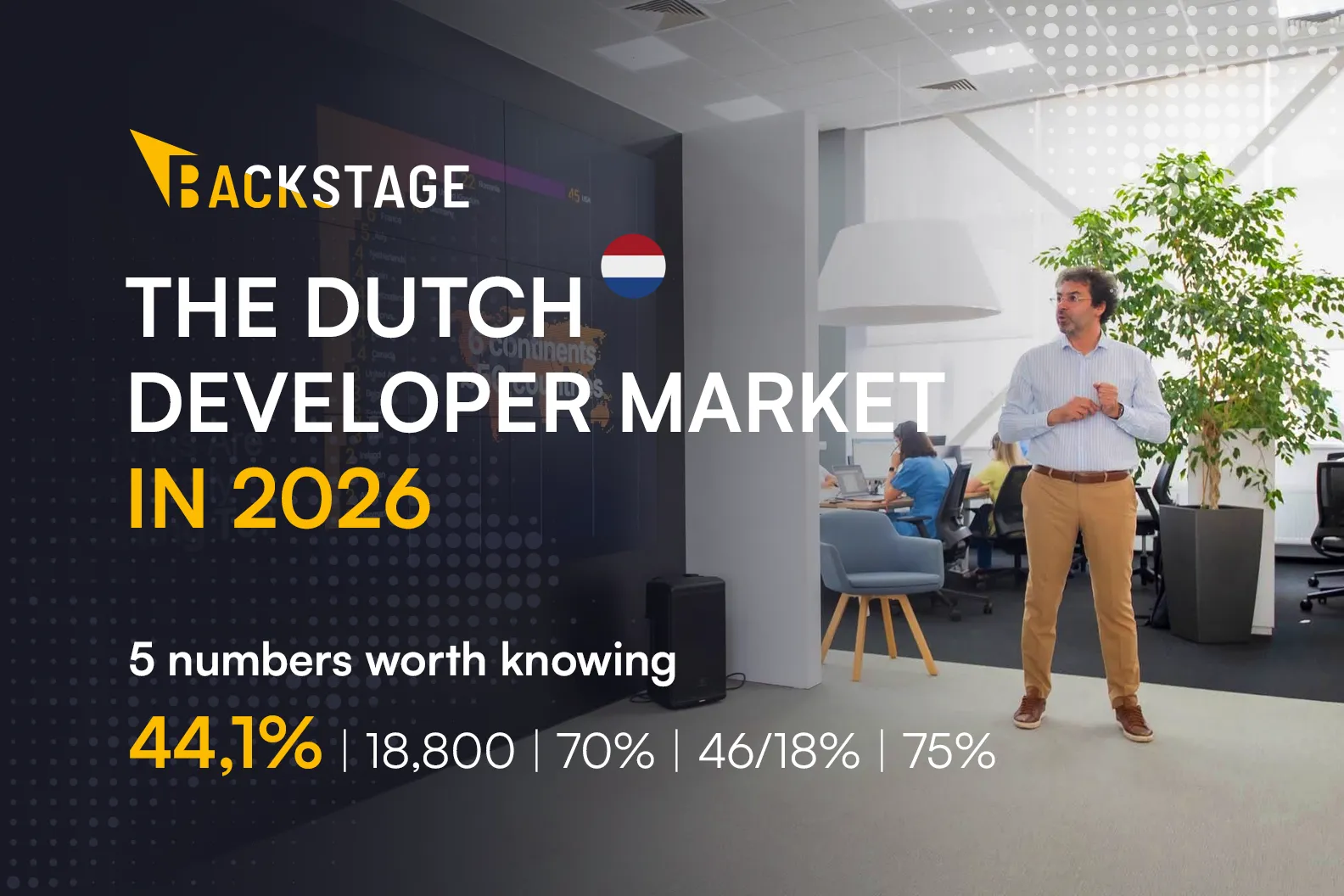
The Dutch developer market is cooling and getting narrower at the same time. ICT vacancies have been falling since 2023, while 70% of companies in information and communication already run at least one AI technology. We read the 2025 and 2026 figures from CBS, the Dutch national statistics office, and UWV, the government agency that publishes the country’s labour market data, because clients keep asking us the same question: which developer will they need next year?
What is changing in the Dutch developer market in 2026?
In April 2026, 44.1% of Dutch tech companies increased automation because of staff shortages. Almost 18,800 ICT vacancies were open at the end of 2025. 70% of tech companies use AI. 46% of employers expect AI to add jobs and 18% expect it to cut them. 75% of employers who cannot fill an ICT vacancy point to missing knowledge.
Together those five figures describe a market with fewer openings and a sharper definition of who fits them.
Why are Dutch tech companies automating more?
CBS asked Dutch companies in information and communication how they respond to staff shortages. In April 2026, 44.1% said they were increasing automation, against 28.5% a year earlier. Hiring is still part of the answer. Alongside it, companies are asking what technology, including AI, lets their current team take on.
Both percentages come from the same CBS series one year apart, so the comparison holds within one sector. In software companies the shift shows up in ordinary planning: the question on a task is which part of it a tool can carry, and which part needs the person who knows the product.
Are there still open ICT vacancies in the Netherlands?
Yes. The Dutch ICT labour market has cooled since 2023 and the number of vacancies has fallen, software developers included. UWV still counted almost 18,800 open ICT vacancies at the end of 2025. That figure covers ICT occupations broadly, so it holds more than developer roles. Demand for tech talent has not gone away.
What changes is the type of talent. Finding a developer is easier than it was a few years ago. Finding one with the right technical experience, a product mindset and, increasingly, AI skills is a different search.
How many Dutch tech companies already use AI?
70% of companies in information and communication use at least one AI technology, according to the CBS figures on digitalisation and the knowledge economy for 2025. Across all Dutch companies with ten or more employees, adoption went from 23% in 2024 to 33% in 2025. The tech sector runs well ahead of the Dutch economy as a whole.
That settles the adoption question for most tech companies. The practical questions now are where AI adds value, how it fits into existing products and processes, and which skills a team needs to use it well.
Will AI remove developer jobs in the Netherlands?
Most employers in the sector expect the reverse. UWV found that 46% of employers in Dutch information and communication expect AI to create jobs, while 18% expect jobs to disappear. The same UWV forecast for 2026 to 2028 reports that shortages of specialised ICT professionals persist. The open question is which developers companies will need.
AI already helps with research, debugging, documentation, unfamiliar code and repetitive tasks. Someone still has to understand the product, make the technical decision and spot the moment the model gets something wrong. That combination makes a good developer more productive.
Why is hiring still hard in a cooler market?
UWV puts the figure at 75%: three out of four employers who struggle to fill an ICT vacancy name a lack of professional knowledge among candidates as one of the reasons. Employers look for specific technical knowledge, and UWV also points to understanding of business processes, communication and social skills.
In 2026 another skill enters that mix: working effectively with AI. AI makes a strong developer faster on code, research and repetitive work. The experience to make the right technical decision, to read the business behind a product and to know when to distrust the output comes from somewhere else. That combination is what a cooler market still has few of.
What does this mean for a development team in Moldova?
Developers in Moldova are going through the same shift. In spring 2026, Moldova Innovation Technology Park surveyed 1,560 resident companies about AI: 78% said they already use it, extensively or in parts of the business. Among companies that use or test AI, 79% apply it to software development, code generation or quality testing.
We see it in the profiles our clients ask for. AI knowledge comes up more often, developers use AI tools in their daily work, and some clients are adding AI to an existing product while others are building an AI product from scratch. Why we chose Moldova covers the country itself: the technical tradition, the one-hour time difference and the way developers join an existing team.
Backstage IT builds development teams in Chișinău from the Netherlands, with 130+ developers currently in Extended Teams®. Recruitment, the office and HR there sit with us; the client directs the work.