Moldova and the EU: what already applies
Moldova joined SEPA on 6 October 2025 and the EU roaming area on 1 January 2026. The country has held candidate status since June 2022 and has been negotiating accession since June 2024.
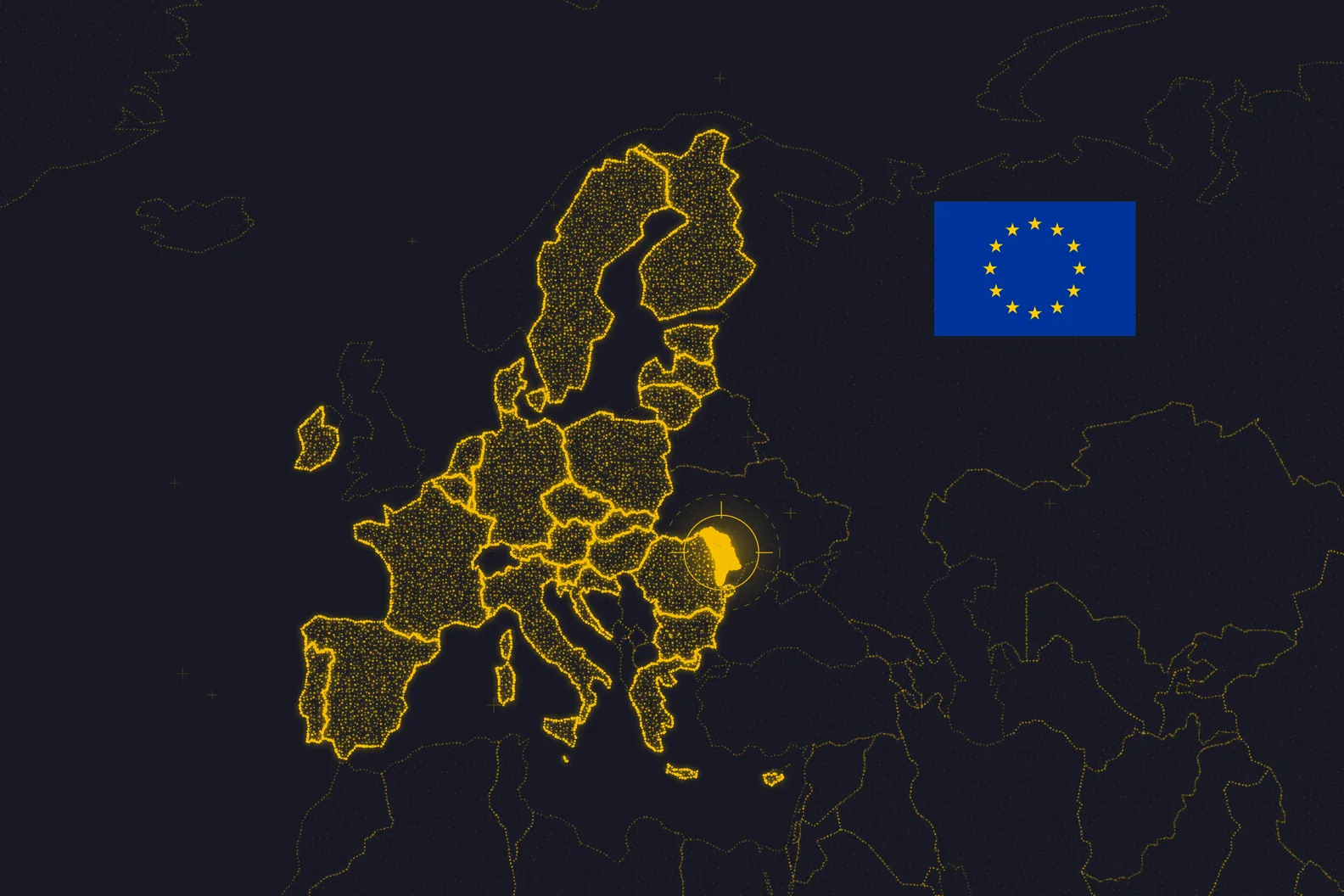
We have worked with development teams in Moldova for 17+ years and have watched the list of differences with the EU grow shorter, by two items in the past year: payments and roaming charges. A euro transfer to a Moldovan IBAN and a phone call from Moldova therefore work differently than they did a year ago.
Payments: now routed through SEPA
On 6 March 2025, the European Payments Council approved Moldova’s inclusion in the geographical scope of the SEPA payment schemes. Since 6 October 2025 that connection has been operational: eight Moldovan commercial banks hold SEPA Participant status. That scope reaches wider than the EU: Moldova is not in the eurozone and not in the European Economic Area.
A payment in euros to a Moldovan IBAN has since been processed as an ordinary SEPA credit transfer. Previously such a payment ran as an international transfer, through a chain of intermediary banks, with the administration that comes with it: an agreement about who carries which costs, and a lead time no one in that chain could guarantee.
Calls and data: no roaming charges
Since 1 January 2026, Moldova falls under Roam Like at Home, the EU’s roaming area. The European Commission confirms the rule works in both directions: calls, texts and mobile data all run at the rate you already pay at home. A trip there and a Moldovan developer joining a sprint in the Netherlands both fall under it.
The EU course in five milestones
| Date | Milestone |
|---|---|
| 23 June 2022 | Moldova receives candidate status. |
| 25 June 2024 | First intergovernmental conference, formal start of negotiations. |
| 22 September 2025 | Screening completed. |
| 15 June 2026 | Cluster 1 (fundamentals) opened. |
| 14 July 2026 | Cluster 6 (external relations) opened. |
A negotiating cluster is a group of subjects from EU law that belong together and are discussed together. Cluster 1 covers the fundamentals: the rule of law, democratic institutions and public administration, among others. Each number belongs to a theme, and a higher number says nothing about how far the negotiations have come.
Source: European Commission, DG Enlargement, Moldova country page. An open cluster means negotiations on those chapters are under way, not that they are closed, and this table deliberately carries no expected accession year: the Commission does not publish one either.
What accession does not change
The negotiations concern Moldovan legislation. Labour law and contract forms for staff in Moldova remain Moldovan national law until accession is complete.
Moldova IT Park, founded in 2018 and with around 2,725 registered companies for 2025, operates under a single 7% tax. That rate is legally guaranteed until 2035 and runs separately from the accession negotiations.
Accession itself remains a process of years, in which every cluster opening again requires all 27 member states to agree.
Security: a timeline toward NIS2
Since April 2026, the EU Partnership Mission in Moldova (EUPM Moldova) and the Moldovan cyber agency have worked together on a formal Cooperation Plan for 2026. One priority is implementing Moldova’s Cyber Security Law (law 48/2023), which Moldova, according to its own cyber agency, is aligning with the European NIS2 standard; that alignment is still under way.
What you arrange yourself
SEPA and roaming apply to the whole country and say nothing about access to a repository or a production environment. Who gets that access, and what the confidentiality agreement says, is set by a client at the start of an engagement.
Backstage IT builds development teams in Chișinău from the Netherlands, with 130+ developers currently in Extended Teams®. Recruitment, the office and HR there sit with us; the client directs the work. Why we chose Moldova covers the country itself: the technical tradition, the one-hour time difference and the way developers join an existing team. Nearshoring for Dutch companies covers the practice: around 3 hours’ flight from Amsterdam, English as the working language, and which tasks sit with us and which with the client.